
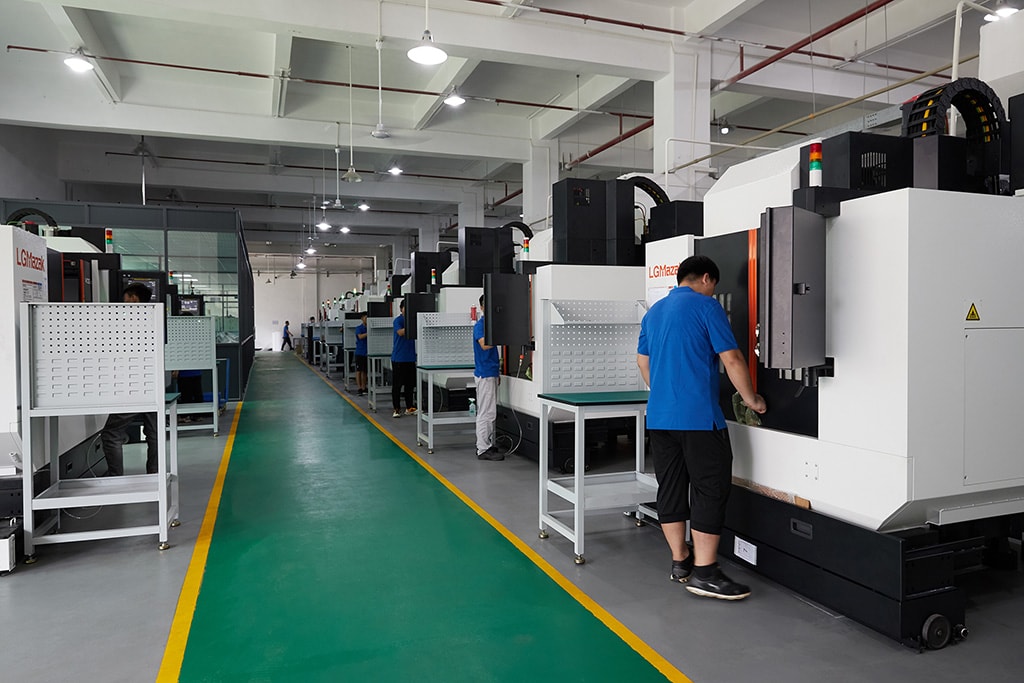
- 100+ production machines — 3-axis (50+), 4-axis (20+), 5-axis (20+), 25+ lathes, 7+ grinders. ±0.003 mm milling / ±0.002 mm turning, ±0.002 mm grinding.
- MOQ 1 piece; lead times ~3 / 7 / 30 days.
- Surface finishing + heat treatment bundled so parts arrive finished.
The short answer: process selection is where machining cost is won or lost. Route a flat bracket to a 5-axis machine and you pay for capacity you never use. Route a five-face part to a 3-axis machine and you pay for fixtures, flips, and scrap. A shop that owns the whole range can route each part by its geometry instead of forcing every part through the one machine it happens to have.
How does process selection drive total cost?
Every process has a cost envelope made of three things: the machine-hour rate, the number of setups, and the fixturing it needs. The lowest-total-cost part is the one machined on the process that reaches every feature in the fewest setups. Milling is cheap per hour but pays for each re-clamp. Turning holds a round part in one clamping but cannot do prismatic work. Mill-turn does both without re-clamping. Grinding reaches tolerance that cutting cannot. Matching the process to the geometry is the whole game.
Which process suits which geometry?
| Geometry | Right process | Why |
|---|---|---|
| Flat plates, brackets, housings, fixtures | 3-axis milling | Orthogonal features reachable from one side; lowest rate |
| Angled holes, wrapped faces | 4-axis milling | Rotary holds the angle, avoids custom fixtures |
| Curved, multi-face, complex surfaces | 5-axis milling | One clamping replaces five flips |
| Shafts, pins, bushings, round parts | CNC turning | Round work in one clamping, fastest for cylinders |
| Round parts with milled features | Mill-turn | Turn and mill without re-clamping |
| Bearing seats, roundness-critical faces | Precision grinding | ±0.002 mm finish cutting cannot reach |
What does 3-axis milling cover?
3-axis milling is the workhorse for prismatic parts, and it is the cheapest way to make any geometry reachable from one side. With 50+ centers and a 1300 × 700 × 600 mm envelope, it handles the majority of brackets, plates, housings, and fixtures that a hardware team designs in the first place. The deciding test is one question: can a straight-down tool reach every critical feature? If yes, or yes after one flip, 3-axis is correct and anything more is wasted cost.
When do 4-axis and 5-axis earn their premium?

More axes are not "better" — they are a tool for a specific job. The 4th axis adds a rotary so an angled hole or a wrapped face is machined in one clamping instead of with a custom fixture. The 5th axis tilts the spindle or the table so curved and multi-face geometry is reached in a single setup. The signal that it is worth the premium: the alternative would be multiple flips whose tolerance stack-up, fixture cost, and scrap risk exceed the higher machine rate. A shop that owns both will tell you which side of that line your part sits on.
What does CNC turning and mill-turn add?
Turning is the fastest, cheapest way to make any round part — a rotating workpiece against a fixed tool reaches a shaft's full profile in one clamping. Mill-turn centers take that further by adding a live milling spindle, so a round part with flats, keyways, or cross-holes is finished in one setup instead of moving between a lathe and a mill. That single-clamping strategy is exactly what keeps tolerances tight and cost down on complex round components.
What does precision grinding add that cutting cannot?
Grinding is a second operation that earns its cost when a surface or diameter must hold ±0.002 mm or a fine finish that milling cannot reach. Surface, centerless, and cylindrical grinding cover flat faces, long bars, and outer diameters respectively. The buyer discipline is the same as with tolerances: grind only the surfaces that need it, because every unnecessary grinding step adds cost without adding function.
What are the hidden costs of mis-routing a part?
- Forced onto the wrong machine — a shop that only has 3-axis will charge you for custom angled fixtures on a part that should have gone on a 4th axis.
- Upsold to unneeded axes — a flat bracket quoted on 5-axis carries a premium for capacity the part never uses.
- Outsourced steps — if grinding or heat treatment leaves the building, lead time and freight grow and accountability splits.
- Re-clamping stack-up — every extra flip is a chance for a datum error that turns into scrap.
Ask any shop which machine your part will actually run on, and why. A clear answer — "3-axis, because it is flat and single-sided" — tells you the quote is honest.
Which materials and finishes does the service cover?

The service runs the materials buyers actually specify — aluminum, stainless steel, carbon and alloy steel, brass, copper, titanium alloy, magnesium, and engineering plastics — with every incoming lot XRF-checked against its mill certificate. Surface finishing (standard and hard anodizing, plating, powder coating, painting, brushing, mirror polishing) and heat treatment (vacuum, bright, carburizing, nitriding, stress-relief aging) are bundled so the parts arrive finished, not as bare blanks.
How do you choose between milling and turning for a given part?
The first routing decision is the simplest: is the part round or prismatic? A part whose outer profile is a cylinder — a shaft, a pin, a bushing, a spacer — belongs on a lathe, where a rotating workpiece against a fixed tool reaches the whole profile in one clamping. A part whose features are flat faces, pockets, and orthogonal holes belongs on a mill, where a rotating tool moves over a fixed part. The geometry decides, and the decision is usually obvious.
The interesting cases are the mixed ones — a round part with a milled flat, a cross-hole, or a keyway. Those belong on a mill-turn center, which turns and mills in a single setup, or on a sequence of lathe-then-mill that is scheduled in-house so the handoff adds no freight and no outside queue. The routing question is always the same: which process reaches every feature in the fewest setups, because that is the lowest-total-cost answer.
| Part shape | Route | Why |
|---|---|---|
| Round profile, no milled features | CNC turning | One clamping reaches the whole profile |
| Flat / boxy, orthogonal features | 3-axis milling | Lowest rate, straight-down tool reaches everything |
| Round with flats, keyways, cross-holes | Mill-turn | Turn and mill without re-clamping |
| Angled or wrapped features | 4-axis milling | Rotary holds the angle, no custom fixture |
| Bearing seats, roundness-critical faces | Grinding | ±0.002 mm finish cutting cannot reach |
What tolerances does each process hold, and when does it matter?
Tolerance is a process capability, not a shop-level claim. Milling and turning hold ±0.003 mm (milling) / ±0.002 mm (turning); grinding holds ±0.002 mm. The distinction matters because it tells you which process a tight dimension forces — a bore at ±0.003 mm (milling) / ±0.002 mm (turning) stays on the mill or lathe, while a bearing seat at ±0.002 mm routes to grinding. Specifying a tolerance beyond what the process can hold is how a part silently becomes expensive.
| Process | Held tolerance | When you should call for it |
|---|---|---|
| CNC milling | ±0.003 mm | Housings, brackets, prismatic features |
| CNC turning | ±0.002 mm | Shafts, pins, bushings, round parts |
| Mill-turn | ±0.003 mm (milling) / ±0.002 mm (turning) | Round parts with milled features, one setup |
| Precision grinding | ±0.002 mm | Bearing seats, roundness-critical surfaces |
The buyer discipline is the same here as everywhere else: tolerance only the features that control fit and function, and route the rest through general tolerance. A part that routes a non-critical bore to grinding because the drawing over-specified it is paying for a process step it never needed.
How does the machine mix affect lead time and cost?
The machine mix — 50+ 3-axis, 20+ 4-axis, 20+ 5-axis, 25+ lathes, and 7+ grinders — is what turns a routing decision into a schedule. When the process a part needs is available in-house at the right capacity, the part does not wait for an outside vendor's backlog or pay a second freight leg. When the mix is weighted toward the work buyers actually order, the machine rate itself comes down.
For lead time, the mix means a part that needs milling, then turning, then grinding moves between cells in the same building instead of between suppliers. For cost, it means each part runs on the cheapest process that reaches its features, rather than the one machine a smaller shop happens to own. The mix is the physical reason the same drawing often quotes lower from a full-range in-house manufacturer.
What does the DFM review look like for process routing?
The DFM review is where routing gets validated against the drawing before any metal is cut. A good review reads the part the way a machinist would: which features are critical, which are reachable from which side, and whether the tolerances and finishes force a process the geometry would not otherwise need. The output is not a yes or no — it is a list of specific notes that lower your cost.
- Reachability — flags undercuts, angled features, and blind pockets that force extra setups or more axes.
- Tolerance sanity — calls out dimensions that are tighter than the function requires and will inflate cost.
- Finish sanity — flags surfaces finished finer than the function demands.
- Corner and wall limits — notes impossible sharp internal corners and thin walls that will chatter.
- Routing recommendation — says which process reaches the part in the fewest setups, and why.
A DFM review that returns notes like "this pocket is too deep, this corner is impossible, this tolerance is overkill" is the single cheapest cost reduction you can buy, because it happens before the first chip. Ask for it before you commit, and read it as the supplier being honest about your cost.
How do surface finishing and heat treatment bundle into the service?
A machined part is rarely the finished part. Anodizing, plating, powder coating, painting, brushing, polishing, and heat treatment are the steps that turn a bare machined blank into the component that installs. Bundling them means the machinist stays accountable for the finished part and you get one invoice and one point of contact, instead of a bare blank and a surprise.
The service bundles standard and hard anodizing, zinc, nickel, silver, gold, and chrome plating, powder coating, painting, brushing, and mirror polishing, plus heat treatment — vacuum, bright, carburizing, nitriding, and stress-relief aging. In-house ovens reach 500 °C, which covers aluminum and low-temperature steel stress relief; titanium stress relief above that is outsourced to a qualified partner and stated honestly. The discipline is to apply each step only where the function pays for it, and to know who owns it.
What should you ask before routing a part?
The routing decision is the supplier's, but if you ask the right questions, you keep it honest. The questions cost nothing and reveal whether a quote is routed by geometry or by habit, and whether a shop is forcing your part through the one machine it owns.
- Which machine will this part run on, and why? A specific answer signals the quote is routed, not guessed.
- How many setups will it take? Fewer setups mean fewer flips, less scrap, and a lower total cost.
- Is this the cheapest process for the geometry, or the one you have? A full-range shop answers differently from a single-process shop.
- Who owns the finishing and heat treatment? Bundled and named is better than outsourced and silent.
- What does the DFM review flag? Notes before quoting are a sign the supplier is managing your cost.
Send a STEP or IGES model plus a 2D drawing, material, surface treatment, and quantity to [email protected], and the routing comes back with the DFM review, so the process choice is explained, not assumed.
What this shop actually runs
If you ask for capability evidence, you deserve a specific answer. This facility operates 100+ CNC machines across 6,800 m2 in Dongguan, China, staffed by 100+ people. The machines, listed by category:
- 5-axis machining centres (10+) - Mazak VARIAXIS I-600 (510/910/510 mm travel, 12,000 rpm, 22 kW, 71.6 N·m, 30-tool BT40) and Mazak INTEGREX I-250H S (B-axis 0.0001°, 24 kW, 124 N·m, 38-tool HSK-A63). Set up for compound-angle parts, single-setup multi-face prismatic work, and aerospace fittings where datum transfer loss is unacceptable.
- 3-axis / 4-axis machining centres (50+) - Brother SPEEDIO S500Z2N / S700Z2N (10,000 rpm, 14/21-tool ATC, 0.7 s tool-to-tool, Z-axis 2.2 G) and Mazak VCE-430A L / VCE-570C L (10,000 rpm, 118 N·m, 24-tool ATC). Set up for prismatic parts, plates, brackets, housings.
- Swiss-type turning centres (10+) - Citizen Cincom A20-3F7 (Φ20 mm, 10,000 rpm), TSUGAMI B0206-III / B0205-III (Φ20 mm, 0.1 µm), STAR SR-32JII / SR-32J Type N (Φ32 mm, 8,000 rpm). Set up for long, slender rotational parts at ±0.002 mm.
- CNC turning centres (20+) - HEADMAN T70M/1250 (720 mm swing, 117 mm bore, 3,000 rpm, BMT75 12-station turret). Set up for shafts, bushings, flanges up to ±0.002 mm.
- Wire EDM (5+) - Sodick AQ535L (550/350/300 mm travel, ±20° taper, 800 kg workpiece). Set up for hardened tool steel, internal splines, sharp internal corners that milling cannot reach.
- Inspection: Hexagon CMM + 20+ gauges - Hexagon CMM for coordinate measurement, plus vision system, profilometer, hardness tester, coating thickness gauge, XRF for material verification. The 10:1 rule (gauge 10x more accurate than the band) is applied to every feature.
- Machine highlights - VARIAXIS I-600: one-setup multi-face 5-axis + MAZA-CHECK auto-calibration; INTEGREX I-250H S: DONE-IN-ONE mill-turn, B-axis 0.0001° + Ai thermal shield; SPEEDIO S500Z2N / S700Z2N: Z-axis 2.2 G + 0.7 s ATC; Swiss-type: guide-bush switchable + 0.1 µm resolution.
Tolerance bands: ±0.003 mm milled, ±0.002 mm turned, ±0.002 mm ground or wire-cut. Capability indices: Ppk >= 1.67 at the initial study; Cpk >= 1.33 ongoing in production.
Certifications: ISO 9001:2015 (116024/A/0001/UK/En) · IATF 16949:2016 (131941/A/0001/SM/En, design clause 8.3 excluded) · ISO 14001:2015 (116024/B/0001/UK/En), held by Dongguan Zhuohang Ltd (USCC 91441900MA4UWT6X39, since 2005).
Service area: we supply Austria, Belgium, the Czech Republic, Denmark, France, Germany, Greece, Hungary, Ireland, Italy, the Netherlands, Spain, Sweden and the United Kingdom in Europe; Brazil, Canada, Mexico and the United States in the Americas; China, Israel, Japan, Singapore and Sri Lanka in Asia; Australia and New Zealand in Oceania; and South Africa in Africa, with worldwide delivery from China.
Contact: Felipe Iglesias, [email protected], +86 13126536955.
Send your drawing — we will route it to the process that costs least overall.
Email [email protected] or call +86 13126536955.
Frequently Asked Questions
Which CNC machining services do you offer?
3-axis, 4-axis, and 5-axis CNC milling, CNC turning, mill-turn machining, and precision grinding (surface, centerless, and cylindrical), plus bundled surface finishing and heat treatment. Each part is routed to the process that costs least overall.
How do you decide which process a part should use?
In short, The geometry decides. Flat and boxy parts route to 3-axis milling, round parts to turning, parts needing angled or wrapped features to 4- or 5-axis, and roundness-critical surfaces to grinding.
What tolerances do your services hold?
Milling and turning hold ±0.003 mm (milling) / ±0.002 mm (turning); grinding holds ±0.002 mm. Critical dimensions are verified on Hexagon CMMs, with process capability Ppk ≥ 1.67 at the initial study on key characteristics and ≥ 1.33 on general characteristics.
What is the minimum order quantity for machining services?
The MOQ is 1 piece. Prototype and single-part work runs on the same machines and tolerances as production, so there is no volume threshold before the service is available.
What are the lead times for machining services?
Roughly 3, 7, or 30 days depending on complexity and the number of process steps. Simple parts ship in about 3 days; parts with surface finishing or many operations fall into the longer 30-day tier.
Can you bundle surface finishing and heat treatment?
Yes — anodizing (standard and hard), plating, powder coating, painting, brushing, polishing, and heat treatment can be bundled. In-house ovens reach 500 °C; titanium stress relief above that is outsourced to a qualified partner.
Do you provide material certificates and inspection reports?
Yes. Incoming material is verified by XRF against the mill certificate, and CMM inspection reports, SPC charts, and material certificates ship with the parts as documented evidence of what was delivered.
How do I get a quote for machining services?
Email a STEP or IGES model plus a 2D drawing, material, surface treatment, and quantity to [email protected]. You get a DFM review and a quote, usually within one business day.
Continue reading: 4 Axis CNC Milling · 5 Axis CNC Milling
Standards referenced on this page
- ASTM B348/B348M-21 — Standard Specification for Titanium and Titanium Alloy Bars and Billets
- ASTM B211/B211M-19 — Standard Specification for Aluminum-Alloy Rolled or Cold Finished Bar, Rod, and Wire
- ISO 9001 — Quality management systems — Requirements